

My husband came home and told me he was losing his position.
He’d braced himself the whole drive home. He expected tears, or panic, or that particular silence that means someone is doing math in their head and not liking the answer.
Instead, I told him I was glad.
He looked at me like I hadn’t understood what he’d said.
I understood exactly what he’d said. I was a stay-at-home mom. His income was the only income. And I was glad.
That probably sounds strange, maybe even a little unbelievable. But it’s the same reason I write about financial preparation today, and it’s not because we got lucky, or because the news didn’t matter, or because I’m naturally calm under pressure. I’m not. It’s because we had already done the work before the news arrived. The relief wasn’t about the job. It was about everything we’d built in the years before that conversation ever happened.
Most families don’t get that experience. Most families never see it coming, not because they weren’t paying attention, but because job loss rarely announces itself early enough to matter. And the gap between the family that falls apart and the family that doesn’t is almost never income.
It’s preparation. That’s it. That’s the whole difference.
This post is for families who are facing a job loss right now, who sense one might be coming, or who simply want to understand what real financial preparation looks like before life forces the question on them. The statistics below aren’t meant to frighten you. They’re meant to show you exactly where most families stand, so you can see clearly whether you’re in a stronger or more exposed position than you realized.
What Actually Happened to Us
My husband had served for decades, combining active-duty and Reserve time. He had already completed more than 30 years of military service and had long ago met the 20-year requirement for retirement. Even so, he still had a few years remaining on his current contract. Then the military decided to encourage longer-serving members to retire early, making room for the next generation of service members. Because of his years of service, he was included in that group.
It wasn’t a decision on the timeline we’d have chosen ourselves. But it wasn’t entirely unexpected, either. We’d known, in the back of our minds, that this day would eventually come.
The Timeline Changed Overnight
What we didn’t expect was how quickly everything would move once it started.
The military gave us a few months. Not years. A few months to decide where we wanted to live, complete every out-processing requirement, transition every benefit, update every record, and prepare our family for a completely different chapter of life. If you’ve never been through a military transition, it’s easy to picture it as a resignation letter and a last day at the office. It isn’t. It’s a long, detailed process compressed into a short, unforgiving timeline, and everything seems to happen at once.
Here’s what carried us through it: for years before that day, we had been paying off debt. Reducing expenses we didn’t need. Building savings on purpose, not by accident. None of it was done because we knew this exact moment was coming. It was done because we’d decided, a long time before, that we wanted options instead of surprises.
So when the news finally came, it wasn’t the crisis most people would expect. We had already prepared for that possibility. It simply marked the start of a new chapter, one we were financially ready to walk into, even if we weren’t entirely emotionally ready for it yet.
That’s the part I want you to sit with. Not the ending. The years before the ending, when nothing dramatic was happening, and we were just quietly building room to breathe.
What the Numbers Show About Job Loss in America
Job loss is not rare. It’s not something that happens only to careless workers or struggling companies. It happens consistently, across industries, income levels, and career stages. Understanding how common it actually is changes the way you think about preparing for it.
- 1.8 million Americans are laid off or discharged every single month (Bureau of Labor Statistics, JOLTS 2025)
- 40% of American workers have experienced at least one layoff in their career (Pew Research Center)
- 23 weeks — the average duration of unemployment after a job loss in 2025 (Bureau of Labor Statistics, 2025)
- 28 days — the average financial runway U.S. households have after a sudden loss of income (Financial Health Network, 2024)
- 45% of prior wages replaced by the average state unemployment benefit (Department of Labor, 2025)
- 63% of Americans would struggle to cover a $500 emergency expense without borrowing
- 37% of Americans would struggle to cover a $400 emergency expense without borrowing
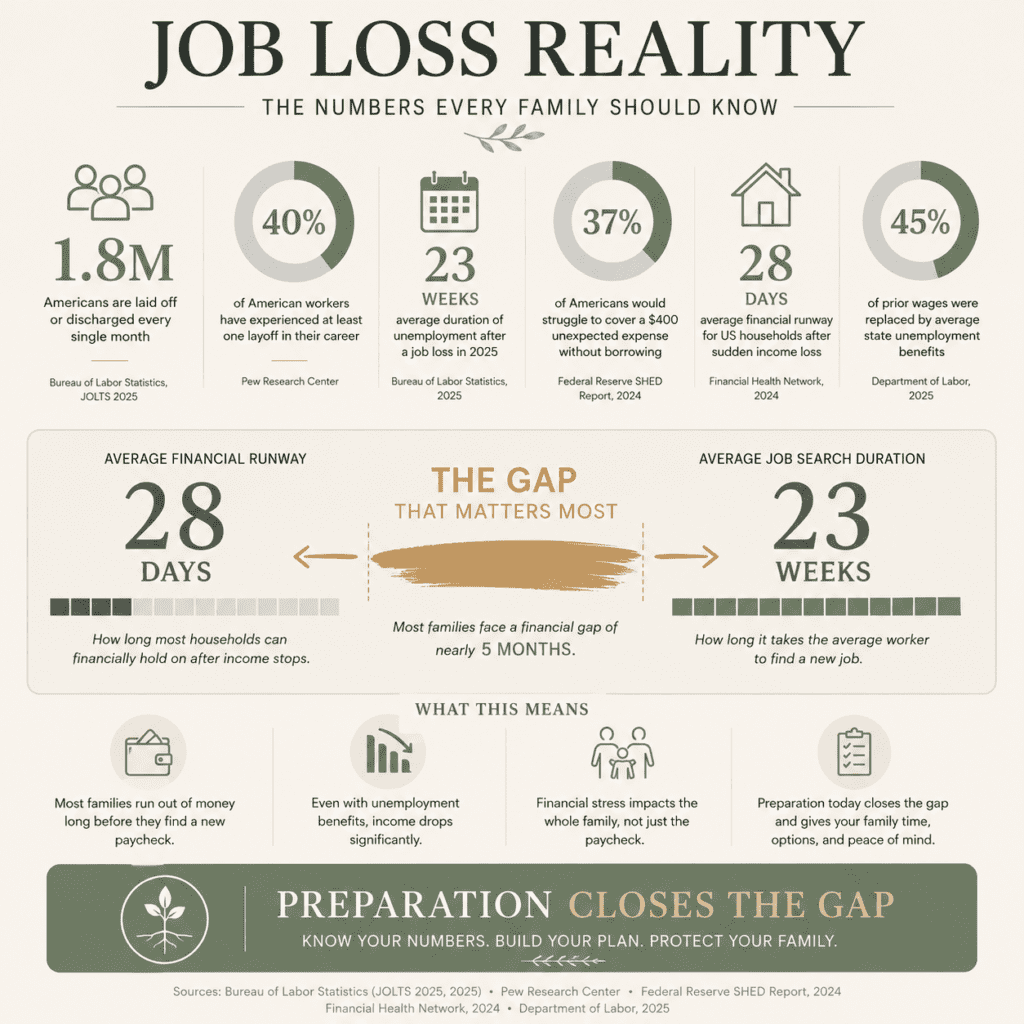
The gap that matters most: the average job search lasts approximately 23 weeks. The average household can sustain itself for about 28 days after income stops. That five-month gap isn’t a worst-case scenario. It’s the median American experience. Preparation is the only thing that closes it.
The Questions Families Are Actually Asking
After income stops, the questions come fast, and they tend to arrive in roughly this order.
How long do I actually have before something breaks down financially?
Start by calculating your minimum monthly household expenses. Add up your housing, utilities, insurance, minimum monthly debt payments, and groceries at a reduced level. Then divide your savings by that number. That’s how many months your savings can realistically cover your essential expenses. Most families discover they have less time than they assumed, and it’s much better to know that now than to find out later.
What happens to our health insurance?
When employer-sponsored coverage ends, most families have three options. COBRA lets you keep the same plan, but you now pay the full premium your employer used to cover; nationally, that averages around $1,800 a month for family coverage. Marketplace plans through the ACA are often significantly cheaper, and job loss qualifies you for a special enrollment period. Medicaid may also be available depending on your household income after the job loss.
Compare all three before assuming COBRA is your only path; it usually isn’t.
Should I apply for unemployment benefits right away?
Yes. In the first week. Most states have a waiting period before benefits begin, which means every day you delay is a day of benefits you simply don’t get back. Average state unemployment benefits replace about 45% of prior wages, with substantial variation across states. That’s not a full replacement, but it’s meaningful income during a transition, and there’s no penalty for applying and not needing it. There is a real cost to applying late.
Should we pull money from our retirement accounts?
This is one of the most consequential decisions a family can make during a job loss, and it deserves real caution. Early withdrawals from a 401(k) or IRA before age 59½ are typically hit with income tax plus a 10% penalty. On a $10,000 withdrawal, a family in the 22% tax bracket loses roughly $3,200 to taxes and penalties before they ever see the money. Explore every other option first: unemployment benefits, expense reductions, creditor hardship programs, family resources, before touching retirement accounts.
How do we talk to our kids about what’s happening?
Children handle financial stress better when they have age-appropriate information than when they sense tension without context. For younger kids, simple and calm works best: a job change is happening, the family is adjusting, and everyone is safe. For older kids and teens, honest conversations about reduced spending and household changes tend to build more trust than silence does. The research on family financial stress is consistent on this point: kids are more affected by parental anxiety than by the actual financial situation itself.

How do we tell creditors without damaging our credit?
Call before you miss a payment, not after. Lenders have hardship programs, deferment options, and reduced payment arrangements available to customers with strong payment histories who reach out proactively, and these programs are rarely advertised, so you have to ask. Once you’ve missed payments, your options narrow fast, and the credit damage has already started. Proactive contact is one of the highest-return moves a family can make in the first two weeks after a job loss.
How long does it realistically take to find a new job?
The Bureau of Labor Statistics reports an average unemployment duration of about 23 weeks in 2025, nearly six months. Entry-level roles tend to move faster. Senior, specialized, or management positions often take longer to fill. Military veterans transitioning to civilian careers report an average search of three to six months, depending on field and location. Planning financially for a six-month transition is far more realistic than hoping for a six-week one. If things move faster than expected, you’ll have prepared for more than you needed, not less.
Why Some Families Come Through Job Loss Stronger
The families who come through income disruptions in the best shape are rarely the ones who had the highest income before it happened. They’re the ones who had already made specific decisions that gave them more options when their income changed.
Households with at least three months of expenses in emergency savings recover from job loss in roughly half the time of households with no savings buffer. The reason isn’t that they have more money sitting around. It’s that they have room to make decisions instead of reacting to them. They can search for the right opportunity instead of grabbing the nearest one. They can negotiate from a position of strength instead of desperation. And most importantly, they can care for their family without financial panic driving every choice they make.
The other consistent factor is timing. Not during the disruption, but before it. The families who call creditors from a position of strength, who’ve already trimmed unnecessary fixed expenses, who already know their household minimum payments, are in a fundamentally different situation than families calculating all of that for the first time under pressure.
This isn’t about blaming anyone who wasn’t prepared. Job loss often arrives faster than anyone expects, and the signals aren’t always visible in time. It’s about making the case, plainly, that the preparation is worth doing right now, before anything changes, because the cost of preparing is almost nothing next to the cost of reacting without a plan.
A Note on Military Transitions
Roughly 200,000 service members transition out of the military every year, and the financial picture looks different from a typical civilian job loss in a few important ways. Retirement benefits may continue, housing and food allowances end, and healthcare depends on whether the member retires or separates. Military retirees generally remain eligible for TRICARE, while those separating before retirement typically need to transition to civilian health insurance.
In our case, because my husband retired from the military, our family remained covered under TRICARE. That meant we didn’t have to shop for civilian health insurance during the transition, which removed one major financial concern and allowed us to focus on the other financial adjustments that came with retirement.
Military transitions are often more predictable than civilian job losses because many service members decide well in advance when they’ll separate or retire. That gives families time to prepare financially. However, not every transition follows the original plan. Changes in force structure, early retirement programs, medical separations, or other military needs can accelerate the timeline with much less notice.
Our experience also shows that even a well-planned military career can change unexpectedly. Although my husband expected to complete the remaining two years of his contract, the Army required him to retire early due to staffing needs. Instead of having those two years to prepare, we had only a few months. Thankfully, we had already been making financial decisions that gave us options when those plans changed.
Our story began with a military transition, but the steps we’re about to cover apply whether you’re facing a layoff, an early retirement, a job loss, or any other unexpected change in income.
Eight Practical Steps for the First Thirty Days
1. Don’t make major financial decisions in the first 48 hours. Fear narrows thinking. Before acting on anything significant, make sure you fully understand what actually happened. Layoff, restructuring, retirement, reduction in force the category matters, because it determines what benefits and options are available to you.
2. Calculate Your Minimum Monthly Expenses. Add up only the genuinely unavoidable monthly expenses: housing, utilities, insurance, minimum debt payments, groceries at a reduced level. Divide your savings by that number. That’s how many months your household can operate. Write it down. That single number changes your emotional response and your planning almost immediately.
3. Apply for unemployment benefits immediately. Most states have a waiting period before benefits begin; apply in week one. Unemployment replaces roughly 45% of prior wages. Not enough to maintain your current lifestyle, but meaningful income during a transition, and it buys you time.
4. Call creditors before you’re late. Mortgage servicers, auto lenders, credit card companies, and student loan providers all have hardship programs for customers with strong payment histories who reach out first. Call and ask what exists, not because you need it yet, but because you want to know before pressure forces your hand.
5. Address health insurance within the first two weeks. Compare COBRA, ACA marketplace plans, and Medicaid eligibility. Job loss qualifies you for a special enrollment period, so you don’t have to wait for open enrollment. COBRA is often the most expensive option; check the alternatives before defaulting to it.
6. Reduce monthly obligations immediately, not permanently. Pause unnecessary subscriptions. Delay large purchases. Review every recurring charge. The goal is lowering monthly pressure while you build a clear plan, so your decisions come from stability instead of urgency. Most of these cuts can be reversed once income returns.
7. Build a thirty-day action plan, not a five-year plan. Job applications, an updated resume, networking conversations, healthcare decisions, financial calls- break the large problem into this week’s steps. A big problem handled in thirty-day increments becomes manageable. The same problem viewed all at once becomes paralyzing.
8. Keep the household running normally where possible. Routines, meal planning, consistent sleep, regular communication between partners- all of it meaningfully reduces household stress during uncertain periods. Children are more affected by parental anxiety than by the financial circumstances themselves. A household that continues to function as a household weathers financial transitions better than one that slides into crisis mode.

The Thing That Changes Everything
A job loss is a financial event. It is not a personal failure.
It happens to hardworking, responsible, well-prepared people every day, people who did nothing wrong and still got the phone call, the email, the conversation in the car on the way home.
What separates the families who recover quickly from the ones who spend years trying to catch up is usually not income. Education helps, but it isn’t the deciding factor. Luck plays some role, but it’s rarely the thing that actually determines the outcome.
The real difference is breathing room.
It’s the margin between what comes in and what goes out. It’s the savings that turn a crisis into an inconvenience. It’s the lower fixed expenses that make a reduced income survivable instead of catastrophic. It’s knowing your own numbers well enough that fear doesn’t get to fill in the blanks where clarity should be.
When my husband walked in that day and told me he was being transitioned out, I wasn’t calm because I knew exactly what would happen next. Nobody knows exactly what happens next. I was calm because we had already done the work before the news ever arrived. We had built breathing room, on purpose, for years, without knowing exactly when we’d need it.
The timing was always going to be uncertain. What we knew for certain was that preparing in advance was worth doing regardless of when the day came.
That’s what I want to help you build. And it starts with understanding one number: the minimum amount your household needs each month to remain financially stable.
Find Out Where Your Household Actually Stands
The free One-Income Decision Calculator walks you through your real monthly numbers, helps you calculate your minimum monthly household expenses, and shows you how long your savings can realistically cover those essential expenses. Get the Free Calculator

The process takes about 30 minutes from start to finish. Most of that time is spent gathering pay stubs, bills, debt balances, childcare costs, and other financial information you likely already have on hand. Once your documents are in front of you, entering the numbers typically takes only 5 to 10 minutes, and your results are calculated instantly.
Most families discover at least one expense, assumption, or financial gap they didn’t expect to find.
One question for you: if you’ve been through a major income disruption, what’s the one thing you wish you had known beforehand? I’d genuinely like to hear it in the comments.