

Our paid-off SUV was totaled. Insurance handed us $13,500. We needed a replacement for a totaled car, but most people would have done one of two things: bought the cheapest vehicle they could find or financed a brand-new SUV.
We did neither.
That’s because living well on one income isn’t about being cheap. It’s about making smart financial decisions before you spend the money.
Before I tell you what we bought, here’s why this wasn’t a normal car purchase.
A Little Background
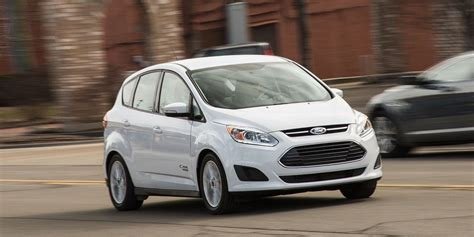
About six years before the accident, my husband was forced to retire from the military. We decided to buy a Class A motor home so we could travel and figure out where we wanted to settle down. Our previous vehicle, a fully loaded Honda Odyssey, couldn’t be flat-towed behind the motor home, so we traded it for a hybrid SUV. It worked well for several years, but as our boys grew into young men, we had already started talking about moving back into a full-size SUV.
Then the accident happened, and suddenly that “someday” decision became today’s decision.
The Market Was Not on Our Side
This was the end of 2024, and the used car market was still feeling the effects of years of elevated prices. According to the Manheim Used Vehicle Value Index, used vehicle prices had climbed more than 40 percent since 2019 and, while they had softened slightly from their 2022 peak, they were still well above pre-pandemic levels. Full-size SUVs were among the hardest-hit categories because demand had stayed high even as inventory slowly recovered.
We looked everywhere: Enterprise Car Sales, Carvana, CarMax, and every used lot we could find within a reasonable distance. Comparable full-size SUVs were selling for $30,000 to $40,000. New ones started around $60,000, and that was before adding the features we actually wanted.
We were not willing to finance a vehicle this time. We have financed vehicles before, including one at 0% interest, and paid them off early. But in this situation, taking on a $500 to $600 monthly payment for the next five or six years made no sense to us when we had a $13,500 insurance check in hand. We wanted to see whether we could use that money to replace the SUV without adding another monthly payment to our budget.
Why We Looked at Auctions This Time
Before we buy any vehicle, we compare all of our options. Over the years, I had researched auction vehicles many times. But once I factored in potential repairs and the absence of any warranty, buying from a dealership usually made more sense. This time was different. The numbers made sense.
There are several types of auto auctions. Some, like Copart and IAA (Insurance Auto Auctions), specialize in salvage and total-loss vehicles. Those carry real risk unless you know exactly what you are looking at. Others, like ADESA (now operating under the OpenLane platform) and Manheim, focus on off-lease, fleet, and dealer trade-in vehicles. These tend to be in better condition, though they still require due diligence. Public access to dealer-only auction lanes has also grown in recent years, and some auctions allow in-person preview before bidding.
The auction we used fell into the latter category. Vehicles are listed with photos, a condition report, and a vehicle history report. Buyers pay the winning bid plus a buyer’s fee, which typically ranges from a few hundred dollars to around ten percent of the sale price depending on the platform and the sale price tier. You also still owe taxes and registration on your end. It is not a magic discount machine, but when the conditions are right, it can be.
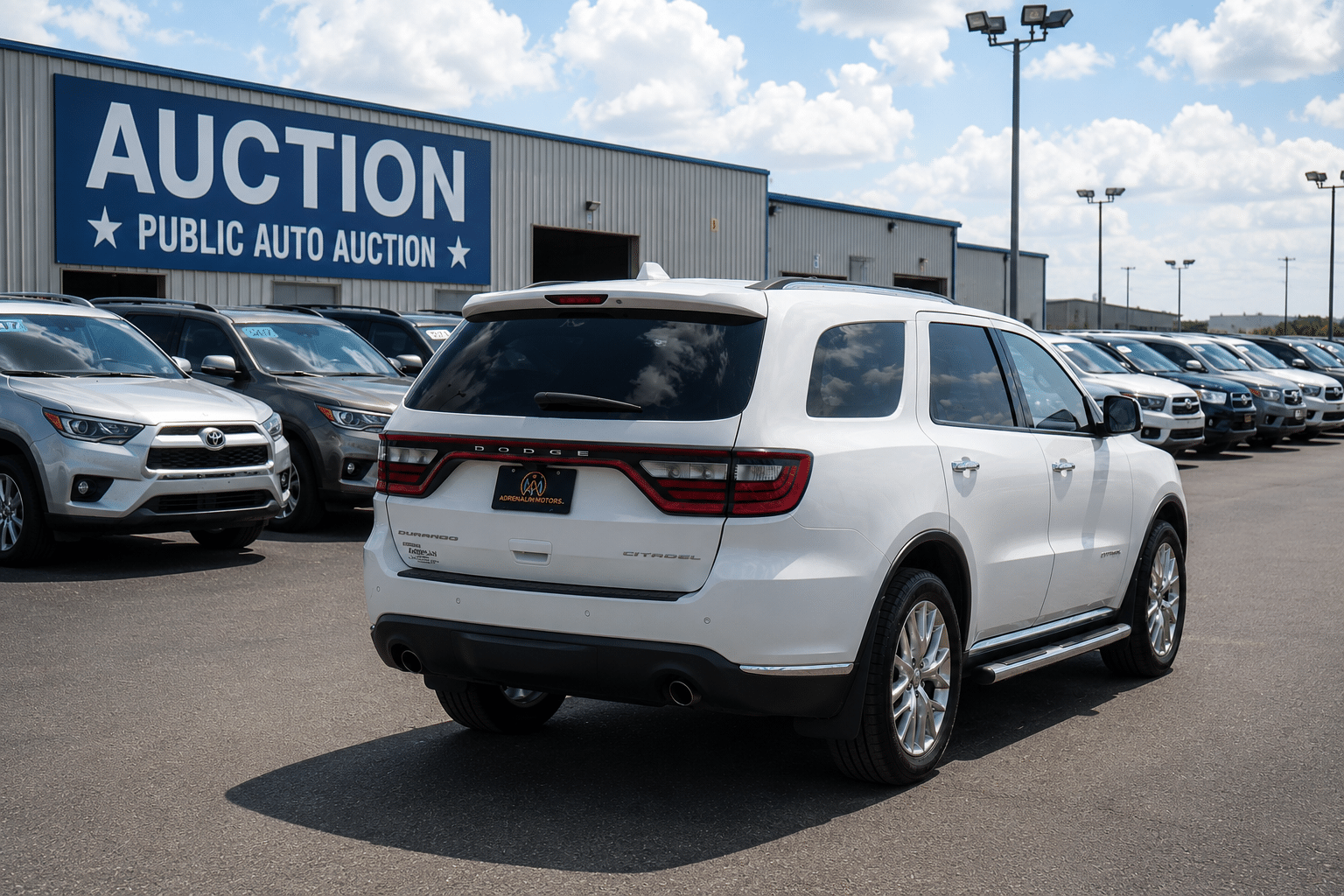
We found a fully loaded 2015 Dodge Durango Citadel listed at an online auction. We found several SUVs we liked online, so we went to look at them in person. The Durango immediately stood out. It was exactly what we had been looking for.
What We Found When We Looked Closer
The 2015 Durango Citadel is the top trim for that generation. It comes with the 5.7-liter HEMI V8, third-row seating, leather heated and ventilated seats, a panoramic sunroof, a rear-seat entertainment system, adaptive cruise control, and a tow rating of 7,400 pounds. At retail, a comparable used example in good condition in our area was priced at $18,000 or more out the door.
The vehicle history report showed it had been in several accidents. That would stop most buyers right there. But when we looked at it in person, the exterior had been repaired beautifully. No dings, no visible damage, no mismatched panels. It genuinely looked new. The body work was better than what you typically see on a used vehicle that had never been in an accident at all. The interior was in great shape as well. For a 2015 with that many miles, it was holding up remarkably well. That told us the previous owner had taken care of the vehicle and put real money into the cosmetic repairs, which meant we were not going to be dealing with rust, hidden damage, or a vehicle that looked like what it had been through.
Once we got home, I researched that exact Durango. I checked the market value using Kelley Blue Book and Edmunds, read owner forums on DurangoForum.com and Ram Truck forums (the 5.7 HEMI is shared across several Stellantis platforms), and watched repair videos to understand what typically fails at that mileage and what those repairs cost. The 5.7 HEMI in this era of vehicles has a known issue with rocker arm failure, particularly on the MDS (Multi-Displacement System) components, which can cause a ticking or misfiring condition. I wanted to know going in that this was a possible repair, roughly what it would cost, and whether it would change my numbers.
Before I ever placed a bid, I wanted to know exactly what I was buying. By then, I already knew what it was worth and what could go wrong with it.
The Bidding Process
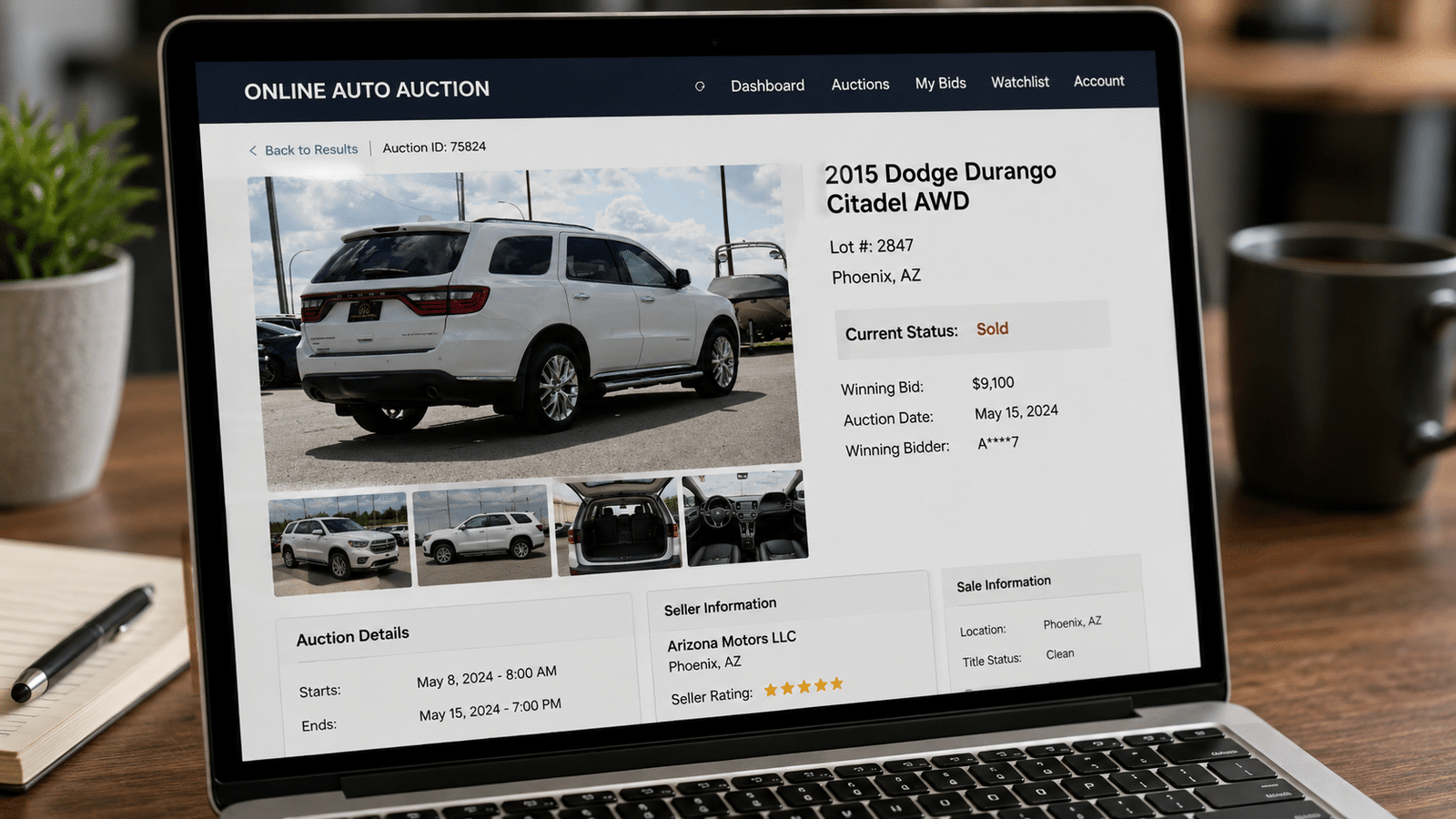
The first time the Durango came up for auction, the bidding climbed to around $10,000 to $11,000. That was more than I was willing to pay given the unknowns, so I let it go. It did not sell.
Before the second auction, I sat down and did the math. If we could buy the Durango for around $6,000 to $7,000, we would still have room to put another $6,000 to $7,000 into repairs and maintenance and come out well below what a comparable full-size SUV would sell for anywhere else. That became my ceiling.
When it came up for auction a second time, I made one phone call first. I called the online auction and asked what their minimum acceptable price was. They do not advertise that information, but it is worth asking because it tells you whether there is any overlap between your number and theirs. Once I knew that number, I also knew exactly where I was willing to stop.
The bidding climbed to around $9,000, and someone else won it. I figured we had missed our chance.
A few days later, the buyer backed out. Because we had already stated our number, the Durango came back to us, and we bought it for $6,500.
By the time we paid the buyer’s fee, taxes, and registration, we had about $7,500 invested in the purchase.
The Diagnosis and Repairs
We took the Durango to AAMCO for a complete diagnostic before committing to any additional repairs. You can certainly take a vehicle to any repair shop you trust, but we chose AAMCO because the diagnostic was free and, in our experience, extremely thorough.
The diagnostic took about four to five hours. They went through the vehicle in detail, checking not only the major systems but also smaller components and wear items that could cause problems later. That gave us a much clearer picture of the overall condition of the Durango and helped us decide whether it made financial sense to put more money into it.
The diagnosis came back better than we expected. The rocker arm issue we had anticipated was there, but the engine did not need to be replaced. The shop replaced the rocker arm assembly along with the cylinder head and valves, which addressed the root cause. Since the engine was already apart, we also replaced the gaskets, refreshed all the fluids, and upgraded several older plastic wear components with updated materials. On the 5.7 HEMI, this included items like the cam phaser bolts and the valley cover, which made sense to replace while the engine was already open and the labor was already being done.
Because we planned to keep the Durango for years, it made sense to replace those relatively inexpensive wear items at the same time. Paying to have the engine opened again later would have meant another substantial labor charge.
We also put on a full new set of tires. We needed one replacement wheel. The dealership wanted $800 for it. I found the exact same used OEM wheel on Amazon for about $90.
One of the windows would not roll up. Before taking it anywhere, I looked it up and found a power window regulator on Amazon for $23. I ordered it, installed it myself, and the window worked fine. That is the kind of repair that a dealership would quote as a $200 to $300 job. With a little research and a $23 part, it took about three minutes, if that.
The Final Numbers
| Item | Cost |
|---|---|
| Auction purchase price | $6,500 |
| Buyer’s fee, taxes, registration | ~$1,000 |
| Engine repair and related work | $4,600 |
| Tires (full set) | ~$700 |
| Replacement wheel (Amazon) | $90 |
| Power window regulator (Amazon) | $23 |
| Miscellaneous supplies and fluids | ~$87 |
| Total | ~$13,570 |
By the time everything was done, we had spent $13,570, just $70 more than the $13,500 the insurance company had paid us. A comparable 2015 Durango Citadel from a dealership in our area would have cost $18,000 or more out the door.
Even after everything we put into ours, we spent thousands less. And because we had already repaired the known wear items on that engine, we knew exactly what had been fixed. If we had bought a comparable Durango from a dealership, we would still have to decide whether to pay extra for an extended warranty, which on a vehicle this age typically runs $2,000 to $3,500, or simply hope those same repairs were not waiting for us down the road.
Instead, we ended up owning a fully loaded 2015 Dodge Durango Citadel outright. No loan. No interest or monthly car payment for the next six years.
Why It Worked
Looking back, the reason that purchase worked was not that we found a bargain. It worked because we had a plan.
Before bidding, we knew the vehicle’s value and understood the specific risks associated with that model and mileage range. We also set a firm total budget that accounted for the purchase price and every likely repair. With those numbers clear, the decision became much easier. There was no guessing or hoping. We were simply executing a plan we had already made.
That is what I mean when I say living well on one income is not about being cheap. It is about doing the research, knowing your numbers, and making decisions with confidence.