
For many families, the decision to have one parent stay home isn’t just about childcare. It’s about running the numbers and figuring out what actually makes financial sense.
When people think about a stay-at-home parent, they often focus on the income being given up. What gets overlooked are the expenses that frequently disappear or shrink when a parent leaves the workforce. Childcare costs, commuting expenses, work clothing, convenience meals, and other job-related costs can consume a significant portion of a paycheck.
In some situations, families discover that the financial gap between two incomes and one income is much smaller than they expected. In others, the savings create more flexibility, reduce stress, and make it easier to build long-term financial stability.
Every family’s situation is different, and staying home is not the right choice for everyone. However, understanding the full financial picture can help you make a more informed decision. In this guide, we’ll explore several financial benefits of being a stay-at-home parent and the ways those savings can impact your family’s budget, goals, and future plans.
Did you know the average family spends over $10,000 a year on childcare for just one child? Add in commuting costs, work clothes, and the expense of eating out on busy days, and it’s no surprise many families discover that a second paycheck barely stretches as far as they expected.
That’s where staying home can actually become a financial advantage. While the choice comes with trade-offs, being a stay-at-home parent can save thousands of dollars each year, reduce stress, and create more stability for your family. From childcare and transportation to food and work-related expenses, the savings add up quickly.
In this guide, we’ll explore the biggest financial benefits of being a stay-at-home parent and how thoughtful planning can help you maximize them.
Key Takeaways
- Staying at home can save thousands each year on childcare and commuting.
- Preparing meals at home reduces food costs and waste.
- You’ll cut work-related expenses like clothes, gas, and lunches out.
- Budgeting and planning are essential to make the transition smooth.
- Stay-at-home parenting also offers non-financial rewards, like stronger family bonds and better work-life balance..
Save on Childcare Costs
Childcare Savings
For many families, childcare is one of the largest expenses in the household budget. Depending on your location, the age of your children, and the type of care needed, costs can easily reach thousands of dollars each year for a single child. Families with multiple children often face even higher expenses.
When one parent stays home, those childcare costs may be reduced or eliminated entirely. In some situations, families discover that the amount they save on childcare significantly narrows the gap between two incomes and one.
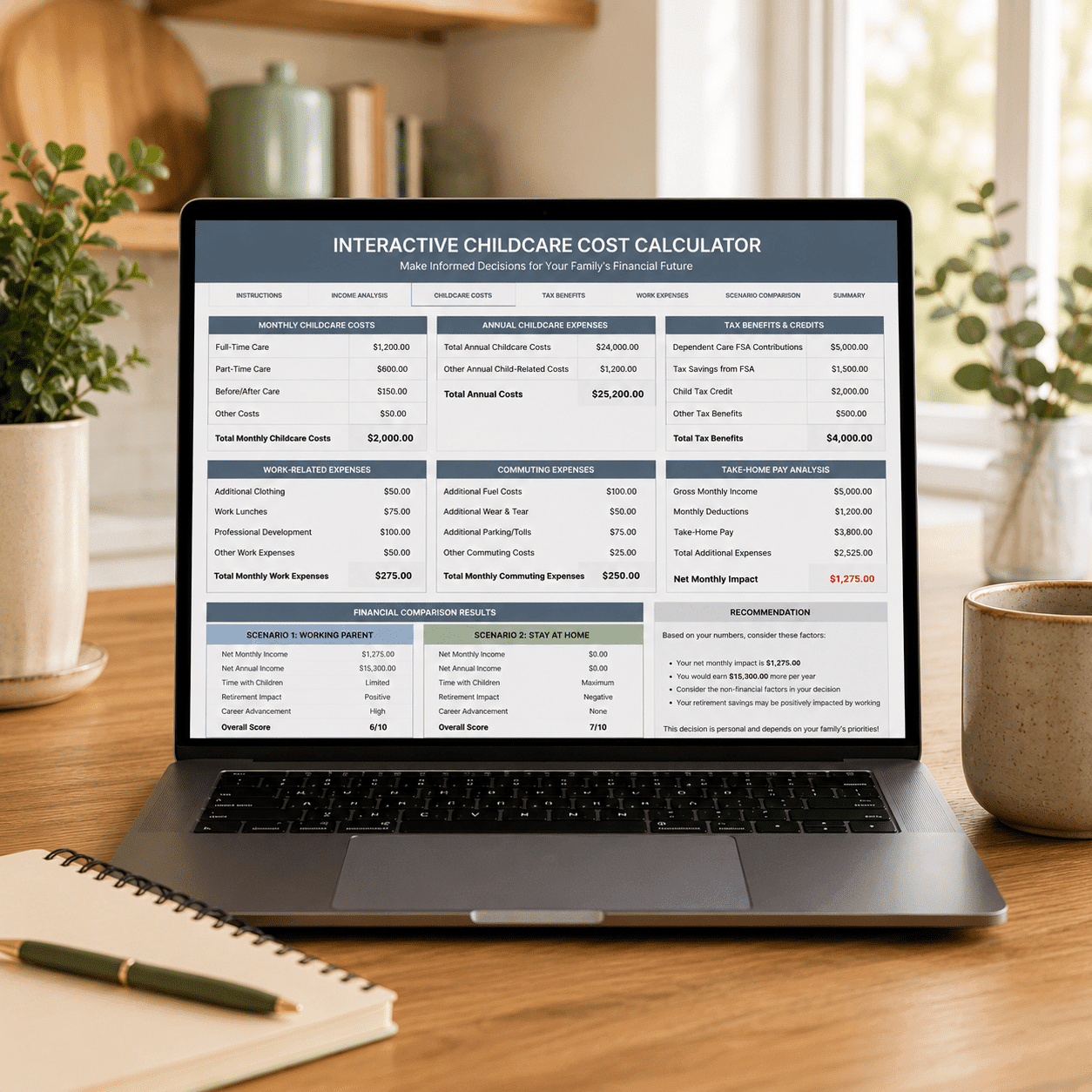
Ready to run your own numbers? Try the Childcare Cost Planner now to compare childcare expenses, work-related costs, and potential savings based on your family’s situation.
Of course, childcare savings are only one piece of the decision. Leaving the workforce may affect current income, future earnings, retirement contributions, and career opportunities. That’s why it’s important to look at the complete financial picture rather than focusing on a single expense.
The goal is not to determine what works for other families. The goal is to understand your numbers, evaluate your options, and make the choice that best supports your family’s financial stability and long-term goals.

Ultimately, reducing childcare costs is just one of the many financial benefits of being a stay-at-home parent. By carefully considering your family’s financial situation and planning accordingly, you can make the best decision for your family’s overall financial stability.
Reduce Transportation Expenses
One of the financial benefits of staying at home with children is the economic advantage of reducing transportation expenses. Parents can save significant money on gas, car maintenance, and commuting costs by staying at home. This not only helps to reduce expenses directly but also contributes to a more eco-friendly lifestyle. Without the daily rush to get to work or school, parents can take time to plan and reduce the number of trips required for errands or appointments.
Lower Food and Meal Expenses
One of the financial rewards for stay-at-home parents is the significant savings that can come from preparing meals at home. Dining out or ordering takeout can be expensive, especially for families with children. However, cooking meals at home can help parents save money without sacrificing quality or taste.
Additionally, by making meals at home, stay-at-home parents can control the ingredients and portions used in their recipes. This can lead to healthier and more cost-effective meals. Parents can also take advantage of sales and discounts at grocery stores and farmer’s markets, further reducing the overall cost of food.
Another financial perk of being a stay-at-home mom or dad is saving on food waste. By planning meals ahead of time and using leftovers creatively, stay-at-home parents can reduce the amount of food that goes to waste. This not only saves money but also promotes sustainability and environmental consciousness.

Save on Work-Related Expenses
Save on Work-Related Expenses
When families evaluate the financial impact of a stay-at-home parent, they often focus on income. However, reducing work-related expenses can also have a meaningful effect on the household budget.
Working outside the home typically comes with a variety of costs, including commuting, fuel, vehicle maintenance, parking fees, professional clothing, convenience purchases, and meals away from home. While each expense may seem small on its own, together they can add up to hundreds or even thousands of dollars each year.
For some families, eliminating or reducing these costs helps offset part of the income that is no longer being earned. It can also simplify daily routines and make monthly expenses more predictable.
Of course, every family’s situation is different. The goal is not to assume that one income will automatically cost less than two. Instead, it’s important to look at the complete financial picture and calculate how much your household currently spends on work-related expenses.
Understanding these costs can help you make a more informed decision and determine whether a stay-at-home arrangement supports your family’s financial goals and long-term plans.

Increase Tax Benefits and Deductions
Being a stay-at-home caregiver may also offer tax benefits and deductions that can help maximize your savings and financial stability. While taxes may not be the most exciting topic, they are an important aspect of financial planning that should not be overlooked.
First and foremost, stay-at-home parents may be able to claim their children as dependents on their tax returns, which can lead to significant tax savings. Additionally, the IRS offers a Child and Dependent Care Tax Credit for parents who paid for childcare while they worked or looked for work. However, since stay-at-home parents are not paying for childcare, they may not be eligible for this credit.
Another tax benefit available to stay-at-home parents is the ability to contribute to a spousal IRA. Even if you do not have earned income, you may be able to make contributions to a traditional or Roth IRA on behalf of your spouse.
It’s important to note that tax laws and regulations can be complex and change frequently. Consult with a tax professional to ensure you are taking advantage of all the tax benefits and deductions available to you as a stay-at-home caregiver.
Build Stronger Family Bonds
While the financial benefits of being a stay-at-home parent are significant, there are also non-monetary advantages that are equally important. One of the most significant benefits of being a stay-at-home parent is the opportunity to build stronger family bonds.
When a parent is at home with the children, they are able to spend more quality time together. This can include activities such as playing games, reading books, or simply talking and enjoying each other’s company. By fostering these relationships, families can create lasting memories and develop a strong sense of closeness.
Additionally, being a stay-at-home parent allows for greater involvement in a child’s daily life. Parents can attend school events, participate in extracurricular activities, and generally be more present in their child’s life. This can lead to better communication, trust, and overall family well-being and happiness.
Overall, the opportunity to build stronger family bonds is one of the most valuable advantages of being a stay-at-home parent. By prioritizing family relationships, parents can create a supportive and loving environment for their children to grow and thrive in.
Enhance Work-Life Balance
One of the significant advantages of being a stay-at-home caregiver is the enhanced work-life balance it provides. By prioritizing family responsibilities and having more control over one’s schedule, individuals can reduce stress and improve their overall quality of life.
It is essential to recognize that being a stay-at-home parent is still a full-time job that requires dedication and effort. However, the added flexibility can allow for more time and energy to pursue personal interests or hobbies.
Continue Learning and Building Future Options
Choosing to stay home does not mean putting personal growth or future opportunities on hold. In many cases, it can create space to learn new skills, explore interests, and prepare for future transitions.
Some parents use this time to complete certifications, take online courses, attend workshops, or develop skills that may support future career goals. Others focus on volunteer work, community involvement, or projects that allow them to build experience while maintaining flexibility for their family.
Personal growth does not always have to be career-focused. Learning new skills, improving household systems, pursuing hobbies, or becoming more involved in your community can all contribute to a greater sense of confidence and purpose.
For parents who eventually plan to return to the workforce, this period can also be an opportunity to stay current in their field, expand their knowledge, or explore new career paths that better fit their family’s long-term goals.
Life circumstances change, and financial transitions often require flexibility. Continuing to learn and develop new skills can help create more options for the future while providing valuable benefits in the present.

Budgeting and Financial Planning
As a stay-at-home parent, budgeting and financial planning are critical for achieving financial stability and success. By creating a budget and sticking to it, you can ensure that you are living within your means and avoiding unnecessary expenses.
Start by analyzing your current spending habits and identifying areas where you can cut back. Look for ways to reduce your monthly expenses, such as by switching to a cheaper cell phone plan or cutting your cable subscription.
Make sure to include all of your expenses in your budget, including groceries, utilities, and any other recurring bills. This will help you stay on top of your finances and avoid any unexpected surprises.
Consider setting financial goals for yourself and your family, such as saving for a down payment on a house or building an emergency fund. By having a clear idea of what you are working towards, you can stay motivated and focused on your long-term financial success.
Track your progress regularly and make adjustments as needed. By continuously monitoring your finances and making smart decisions, you can maximize the financial benefits of being a stay-at-home parent.
Additional Ways to Maximize Financial Benefits
For some families, a stay-at-home parent may eventually choose to bring in supplemental income. While additional income is not required to make a one-income household successful, it can provide extra flexibility for savings goals, debt payoff, retirement contributions, or unexpected expenses.
The good news is that today’s families have more options than ever before. Depending on your skills, interests, and available time, opportunities may include freelance work, consulting, tutoring, part-time remote positions, seasonal work, selling products online, or providing specialized services within your local community.
It’s important to approach additional income with realistic expectations. The primary role of a stay-at-home parent is often managing the household, caring for children, and supporting the family’s daily needs. Any income-generating activities should fit around those responsibilities rather than create additional stress or financial pressure.
For many families, the greatest financial benefit comes not from earning more money, but from creating efficient household systems, reducing unnecessary expenses, planning ahead, and making intentional decisions about how resources are used.
Whether you choose to pursue additional income or focus entirely on managing your household, the key is building a financial plan that supports your family’s goals, priorities, and long-term stability.
| Tip: | Consider your skills and passions when exploring income-generating activities. If you do something you love and are good at, you’ll be more likely to find success. |
|---|
Final Thoughts
The financial benefits of being a stay-at-home parent can be significant, but the decision involves much more than comparing one income to two. Childcare costs, commuting expenses, work-related spending, and daily household costs all play a role in the overall financial picture.
For some families, staying home creates meaningful savings and greater flexibility. For others, the numbers may point in a different direction. That’s why it’s important to evaluate your family’s unique situation rather than relying on assumptions or general advice.
The most successful financial decisions are usually the ones based on careful planning, realistic expectations, and a clear understanding of your options. Whether you’re considering a transition to one income, reducing work hours, or simply exploring different possibilities, taking the time to run the numbers can help you move forward with confidence.
Ultimately, the goal is not to follow someone else’s path. The goal is to build a financial plan that supports your family’s needs, priorities, and long-term stability.
FAQ
Q: What are the biggest financial benefits of being a stay-at-home parent?
The biggest savings come from cutting childcare, commuting, and work-related expenses. Cooking more meals at home also reduces food costs.
Q: Are there tax benefits for stay-at-home parents?
Yes. Parents can usually claim children as dependents, and in many cases contribute to a spousal IRA for long-term savings.
Q: Does staying at home mean giving up career growth?
Not necessarily. Many stay-at-home parents use this season to build skills, volunteer, or start side businesses that can grow into future income.
Q: How can I make the transition financially smoother?
Create a budget, track all expenses, and set clear financial goals. Planning ahead makes it easier to adjust to one income.
Q: What about non-financial benefits?
Stay-at-home parents often enjoy stronger family bonds, more flexibility, and a better work-life balance.